

Google Ads vs Facebook Ads: Which Is Better for Your Business?
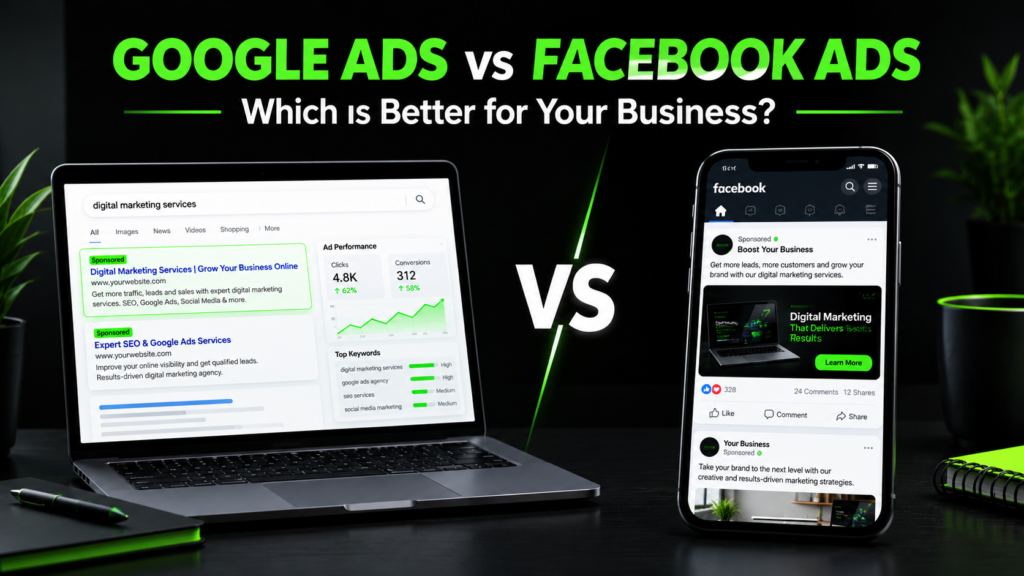
Google Ads vs Facebook Ads is an important comparison for businesses that want to grow online. Both platforms help attract customers; however, they use different advertising strategies. Google Ads targets people searching for products or services, while Facebook Ads helps businesses reach audiences based on their interests. Therefore, understanding these differences can help you choose the right platform for your marketing goals.
The main difference in Google Ads vs Facebook Ads is customer intent. Google Ads helps businesses reach people who are actively searching for products or services. Facebook Ads helps businesses introduce their products and services to people based on their interests, demographics, and online behaviour.
Therefore, the best platform depends on your target audience, business goals, advertising budget, and the way your customers make purchasing decisions.
In this guide, we will compare Google Ads and Facebook Ads, explain their costs and benefits, and help you choose the right advertising platform for your business.
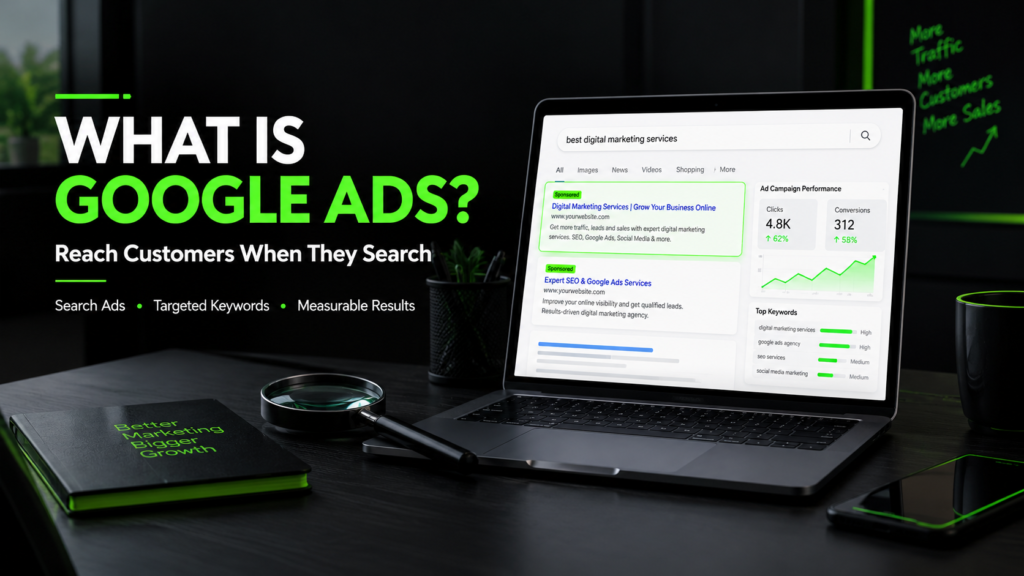
What Are Google Ads?
Google Ads is an online advertising platform that allows businesses to promote their products and services across Google Search, YouTube, and other eligible placements.
For example, imagine someone searches for “digital marketing agency in Chandigarh.” A business running a relevant Google Search campaign may appear among the sponsored results.
As a result, Google Ads can help businesses connect with people who are already looking for a solution. Businesses can also combine advertising with a well-optimised website to improve their online visibility. Learn more about our digital marketing services at Kataria X Digital.
Benefits of Google Ads
1. Reach customers with high purchase intent
Google Search advertising can reach users when they are actively searching for a particular product or service. This makes it useful for businesses that want to attract enquiries and sales.
2. Target specific keywords
Advertisers can select relevant keywords to connect their ads with searches related to their offerings. Effective keyword selection helps improve relevance and manage advertising spend.
3. Generate leads and sales
Google Ads can direct potential customers to a website, landing page, product page, or other relevant destination. With proper conversion tracking, businesses can measure which campaigns generate valuable results.
Businesses that need more enquiries can also explore our digital marketing solutions to understand how advertising can support their growth.
4. Reach local customers
Local service providers can target relevant locations to reach potential customers in their service areas. For example, a Chandigarh-based agency can focus on searches related to digital marketing services in Chandigarh.
5. Measure campaign performance
Google Ads provides reporting tools that help advertisers evaluate clicks, impressions, conversions, and campaign costs.
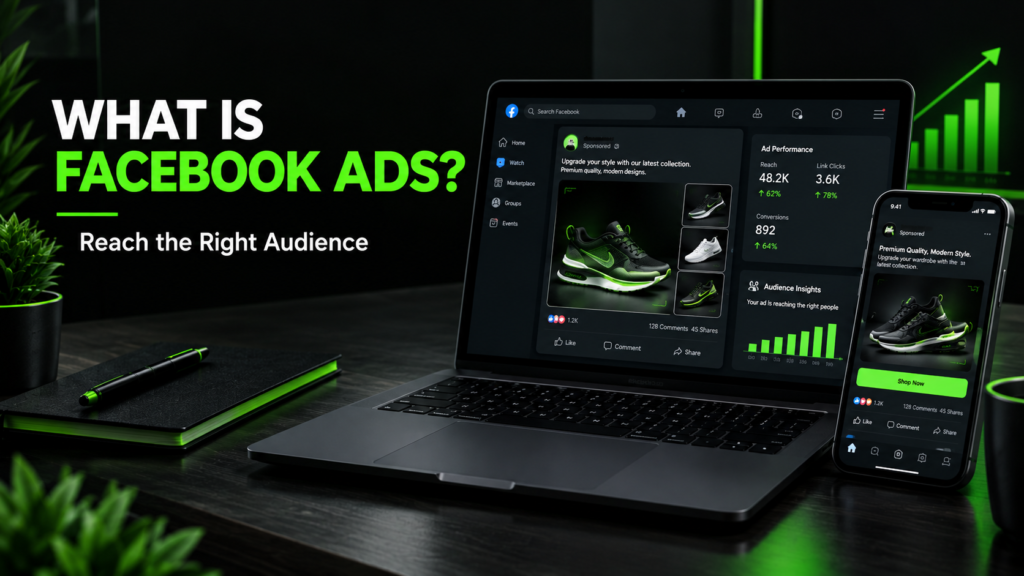
What Are Facebook Ads?
Facebook Ads are paid advertisements delivered through Meta’s advertising platform. Depending on campaign settings and eligibility, businesses can advertise across Facebook, Instagram, Messenger, and other available placements.
Unlike search advertising, Facebook Ads can reach people who are browsing social media rather than actively searching for a product.
For example, a clothing brand can show a new collection to a relevant audience using attractive images, videos, and promotional offers.
Consequently, Facebook Ads are useful for increasing brand awareness, introducing new products, generating leads, and encouraging purchases.
Benefits of Facebook Ads
1. Reach relevant audiences
Advertisers can use available audience controls and targeting options to reach people who are more likely to be interested in their products or services.
2. Use engaging visual content
Images, short videos, Reels, and carousel ads allow businesses to showcase products and communicate their value visually.
3. Build brand awareness
Facebook Ads can introduce a business to people who have not heard about it before. This is particularly useful for new brands and businesses entering competitive markets.
4. Generate leads and enquiries
Businesses can use suitable lead-generation campaigns, website forms, or messaging options to encourage potential customers to enquire about their services.
If you want to attract more customers online, visit Kataria X Digital to explore digital marketing and advertising services.
5. Retarget interested audiences
Where eligible and permitted, businesses can use website or engagement audiences to reconnect with people who have previously interacted with their brand.
Google Ads vs Facebook Ads: Key Differences
Although both platforms support online advertising, their targeting methods, formats, and customer journeys differ.
| Feature | Google Ads | Facebook Ads |
|---|---|---|
| Main approach | Captures existing demand | Builds interest and demand |
| Audience intent | Often higher for relevant searches | Often lower initially |
| Targeting | Keywords, location, audiences and other signals | Audience controls and available targeting signals |
| Ad formats | Search text ads, Shopping, Display and video | Images, videos, Reels and carousels |
| Best suited for | People searching for solutions | Product discovery and brand awareness |
| Lead generation | Search-driven enquiries and website conversions | Lead forms, messaging and website conversions |
| Performance measurement | Clicks, leads, sales and conversion value | Reach, engagement, leads, purchases and conversion value |
The important point is that neither platform is automatically better. Results depend on your industry, offer, audience, campaign setup, and conversion tracking.
Google Ads vs Facebook Ads: Which Is More Cost-Effective?
Advertising cost is an important factor when choosing between Google Ads and Facebook Ads. However, the cheapest click does not always produce the cheapest customer. Google Ads commonly uses a pay-per-click model for Search campaigns, while Facebook Ads uses an advertising auction with costs influenced by campaign objectives, competition, audience, and creative quality.
Google Ads commonly uses a pay-per-click model for Search campaigns, whereas Facebook Ads operates through an advertising auction. However, costs on both platforms vary according to campaign objectives, competition, audience, and creative quality
Google Ads Costs
This platform may be suitable when customers actively search for your services and a qualified enquiry has substantial business value.
However, highly competitive keywords can be expensive. Poor keyword selection and irrelevant clicks can also waste money.
To manage costs, research keywords, use relevant landing pages, review search terms, and track conversions.
Facebook Ads Costs
Facebook Ads can help businesses reach a broad audience and test different creative ideas. However, inexpensive reach or clicks do not guarantee sales.
A campaign may generate engagement without attracting serious buyers. Therefore, advertisers should test different messages, audiences, and offers while measuring qualified leads and actual purchases.
Which platform is cheaper?
There is no universal winner. Compare the cost per qualified lead, cost per customer, and return on advertising spend instead of choosing a platform based only on click prices.
When Should You Choose Google Ads?
Google Ads is often a strong starting point when potential customers already search online for the product or service you provide.
Consider Google Ads if:
- You provide services that people actively search for.
- Customers need a solution quickly.
- Your business depends on enquiries or appointments.
- You sell products that people compare before buying.
- You want to target relevant search terms in specific locations.
For example, a plumber, dentist, web design agency, or repair service may benefit from Google Search campaigns because potential customers often search for these services when they need them.
However, check search demand and competition before investing. If very few people search for your product, search advertising alone may not generate enough opportunities.
When Should You Choose Facebook Ads?
Facebook Ads can be a strong option when your business needs to introduce an offer, showcase a product, or reach people who may be interested but are not actively searching.
Consider Facebook Ads if:
- You sell visually appealing products.
- You are launching a new brand or product.
- Your business relies on attractive images and videos.
- You want to promote offers, events, or seasonal campaigns.
- You want to build awareness among relevant audiences.
For example, a clothing store can use Instagram Reels and Facebook image ads to showcase a new collection. A coaching institute can test promotional creatives to generate enquiries from relevant students and parents.
Nevertheless, successful campaigns require clear messaging, relevant targeting, strong creative content, and an effective follow-up process.
Can You Run Google Ads and Facebook Ads Together?
Yes. In many cases, combining both platforms can support a more complete digital marketing strategy.
Google Ads can reach potential customers who are actively searching for a solution. Facebook Ads can introduce your business to new audiences and help maintain interest through suitable follow-up campaigns.
For example, a digital marketing agency in Chandigarh could use the following approach:
Step 1: Build awareness with Facebook Ads
Promote helpful content, case studies, service benefits, or a relevant offer to reach potential customers.
Step 2: Capture search demand with Google Ads
Run relevant Search campaigns for people looking for digital marketing services in Chandigarh.
Step 3: Improve the website experience
Send visitors to a landing page that explains your services, demonstrates credibility, and provides a clear enquiry option.
Step 4: Track leads and sales
Measure qualified enquiries, booked meetings, and paying customers. Use reliable conversion tracking to understand which campaigns contribute to business results.
Step 5: Optimise based on performance
Review the data regularly and move budget towards campaigns that generate profitable results.
You do not need to run both platforms immediately. Start with the channel that best matches your current goal and available budget, then expand when you have enough evidence to justify it.
How to Choose the Right Advertising Platform for Your Business
Before selecting an advertising platform, consider these five factors.
1. Understand Your Marketing Goal
First, decide whether you want more website traffic, brand awareness, enquiries, appointments, or sales. Your goal determines which campaign types and measurement methods are appropriate.
2. Research Your Target Audience
Find out how customers discover products and services like yours. If they search for solutions on Google, search advertising may be a good fit. If they discover products through social media, Facebook Ads may be more suitable.
3. Set a Realistic Advertising Budget
Choose a budget your business can afford to test consistently. Avoid spreading a small budget across too many campaigns before identifying what works.
4. Prepare a Strong Landing Page or Offer
Advertising cannot compensate for an unclear offer or a poor website experience. Make sure your landing page explains the benefits, builds trust, and makes it easy for visitors to take the next step.
5. Track Meaningful Results
Do not judge a campaign only by impressions, likes, or clicks. Measure qualified leads, purchases, cost per acquisition, and return on advertising spend where appropriate.
These measurements help you make decisions based on business outcomes rather than vanity metrics.
Final Verdict: Google Ads vs Facebook Ads
The right choice in Google Ads vs Facebook Ads depends on how your customers discover and purchase your products or services.
Google Ads is often a good option for capturing existing demand, especially when customers actively search for a solution. Facebook Ads is often a good option for creating interest, showcasing products, and building brand awareness.
For many businesses, a combination of both platforms can be effective. However, the best strategy is to start with a clear goal, test the right channel, track conversions, and improve campaigns using actual performance data.
If you want to grow your business online, focus on reaching the right audience with the right message at the right time.
Need help choosing the right advertising strategy? Visit Kataria X Digital to explore digital marketing services, including Google Ads, Meta Ads, social media marketing, and lead generation.
Frequently Asked Questions
1. Which is better, Google Ads or Facebook Ads?
Neither platform is best for every business. Google Ads is often suitable for reaching people who actively search for a solution, while Facebook Ads is often useful for brand awareness, product discovery, and visual promotions.
2. Are Facebook Ads cheaper than Google Ads?
Facebook Ads may deliver cheaper clicks or impressions in some campaigns, but costs vary. Compare cost per qualified lead or sale to understand which platform provides better value for your business.
3. Which platform is better for small businesses?
Google Ads can work well for local services with existing search demand. Facebook Ads can work well for local promotions, visual products, and building awareness. The right option depends on the audience and business goal.
4. Can beginners run Google Ads and Facebook Ads?
Yes. Beginners can learn both platforms, but they should understand campaign objectives, audience or keyword selection, budget management, and conversion tracking before spending significant amounts.
5. Can Google Ads and Facebook Ads work together?
Yes. Businesses can use Google Ads to capture search demand and Facebook Ads to introduce offers, build awareness, or reconnect with eligible audiences. Both platforms should be measured against shared business goals.
6. How much should a business spend on online advertising?
There is no fixed budget that works for every business. Start with an affordable test budget based on your goals, competition, customer value, and expected conversion costs.
